
Description
Kongsberg MRU 5+ – High-Precision Marine Motion Reference Unit for Dynamic Positioning and Survey Applications
Executive Summary
The Kongsberg MRU 5+ is a high-performance Motion Reference Unit (MRU) designed for precise attitude determination and motion compensation in demanding marine environments. As the flagship model of Kongsberg’s MRU product family, it delivers exceptional accuracy in roll, pitch, and heave measurements using advanced MEMS (Micro-Electro-Mechanical Systems) gyro technology. The MRU 5+ is engineered for applications requiring reliable motion sensing under all dynamic conditions, from small hydrographic survey vessels to large offshore installations. Its solid-state design, high data output rate, and flexible integration options make it a critical sensor for modern maritime automation and survey systems.
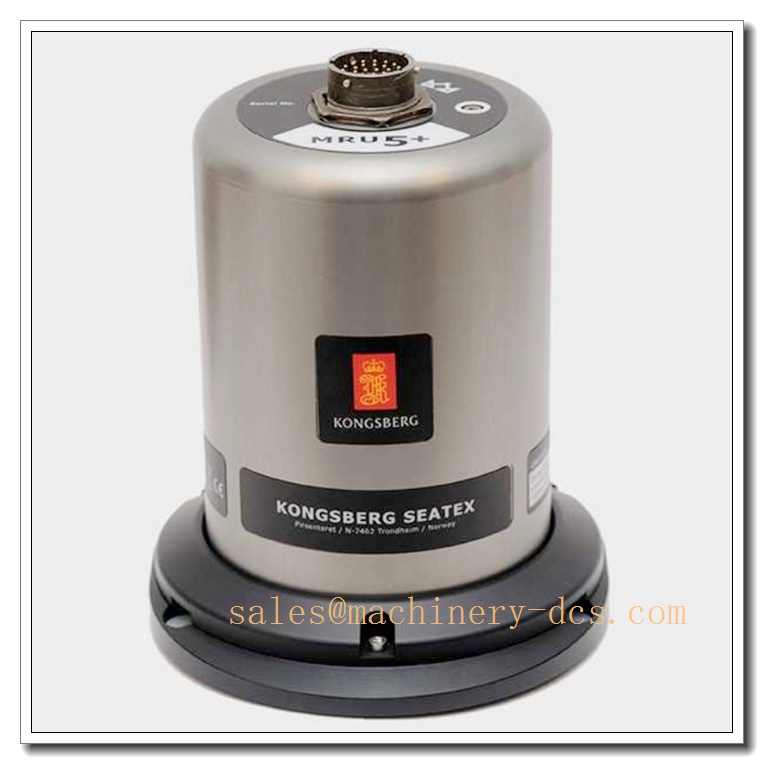
Kongsberg MRU 5+
Core Technical Specifications
- Manufacturer: Kongsberg Maritime / Kongsberg Seatex
- Product Series: MRU (Motion Reference Unit) – MRU 5+ / MRU 5+ MK-II
- Module Type: Marine Motion Reference Unit / Attitude Sensor
- Sensor Technology: Solid-state MEMS gyros (MRG5 type) and triaxial accelerometers; no moving or mechanical wear-out parts
- Roll/Pitch Accuracy: 0.008°–0.01° RMS (at ±5° amplitude) – the highest in the MRU family
- Angle Noise: < 0.002° RMS
- Angle Random Walk: 0.006°/√h (typical)
- Gyro Bias Stability: Typically 4°/h absolute bias
- Acceleration Range: ±30 m/s² (triaxial)
- Acceleration Accuracy: 0.002 m/s² RMS
- Heave Accuracy (Real-Time): 5 cm or 5% of range (whichever is highest), for motion periods 0–25 s
- Heave Accuracy (Delayed Mode): 2 cm or 2% of range, for motion periods 0–50 s
- Heave Output Range: ±50 m, adjustable
- Output Data Rate: Up to 200 Hz
- Communication Interfaces: RS-232, RS-422, and Ethernet (UDP/TCP)
- External Inputs: Accepts external speed and heading data via serial lines for improved accuracy during turns and accelerations; 1PPS time synchronization input
- Configuration Software: MRC+ (Windows-based), with built-in protocols for common multibeam echo sounder systems
- Mounting Orientation: No limitation – can be mounted in any orientation
- Certifications: Each unit delivered with individual calibration certificate; compliant with IHO Special Order standards
Key Features and Advantages
- Best-in-Class MEMS Gyro Technology: Utilizes the Kongsberg-developed MRG5 MEMS rate gyro, offering performance comparable to fiber-optic and ring-laser gyros with exceptionally low angle noise (<0.002°) and bias stability.
- PFreeHeave® Algorithm: A proprietary phase-free heave algorithm that uses past measurements to output correct heave data, providing a significant advantage in long-swell conditions and delayed-mode seabed mapping applications.
- Lever Arm Compensation: Supports definition of vector arms from the MRU mounting point to the vessel’s center of gravity (CG) and up to two individually configurable monitoring points (e.g., transducer head, crane tip), enabling simultaneous heave output at multiple locations.
- High-Speed Data Distribution: Ethernet interface enables easy distribution of MRU data to multiple users on board a vessel simultaneously, simplifying system architecture.
- Plug-and-Play Sonar Integration: Pre-loaded data protocols for the most commonly used multibeam echo sounder systems reduce commissioning time and eliminate manual protocol configuration.
- Solid-State Reliability: No rotating or mechanical wear-out parts ensure very high reliability and minimal maintenance in harsh marine environments.
- No Mounting Orientation Limitation: The internal algorithm compensates for any installation angle, providing installation flexibility on various vessel types.
Application Scenarios
- Hydrographic Surveying: Motion compensation for single-beam and multibeam echo sounders, ensuring accurate seabed mapping in rough sea conditions.
- Dynamic Positioning (DP) Systems: Providing real-time roll, pitch, and heave data to DP controllers for precise vessel station-keeping.
- Offshore Crane Operations: Heave compensation for offshore cranes during subsea lifting and installation operations, improving safety and operational windows.
- AUV/ROV Navigation: Attitude and heading reference for autonomous underwater vehicles and remotely operated vehicles.
- High-Speed Craft Motion Control: Damping and motion control systems for fast ferries and patrol vessels.
- Hydroacoustic Positioning: Motion compensation for USBL/LBL acoustic positioning systems used in subsea operations.
- Antenna Stabilization: Motion compensation and stabilization for satellite communication antennas on moving vessels.
- Structural Monitoring: Monitoring roll, pitch, and linear accelerations on offshore platforms and large vessels for structural integrity assessment.
- Ocean Wave Measurement: Accurate wave height and period measurement for metocean data collection.
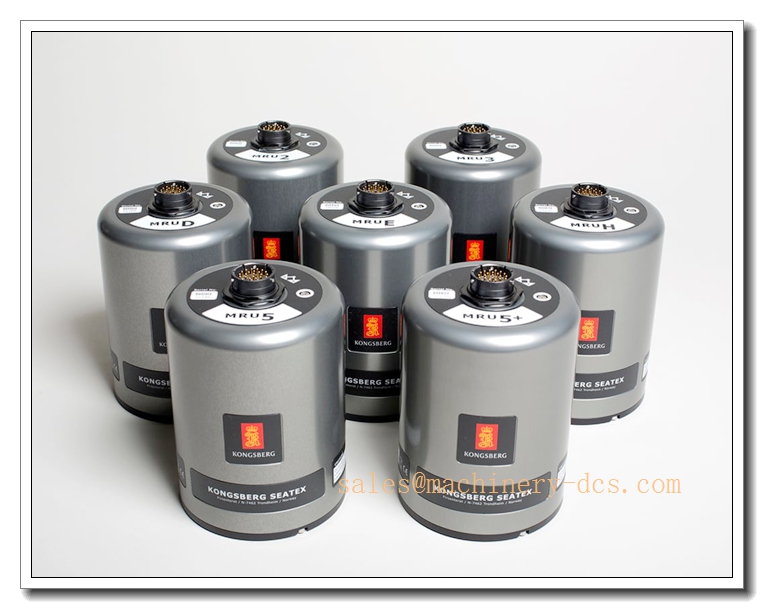
Kongsberg MRU 5+
Related Product Recommendations
For comprehensive marine motion sensing and system integration, consider the following Kongsberg products:
- Kongsberg MRU 5: Previous-generation high-precision MRU with 0.02° roll/pitch accuracy, suitable for slightly less demanding applications.
- Kongsberg MRU E / MRU H: Mid-range MRU models (0.05° accuracy) for general-purpose marine motion sensing.
- Kongsberg MRU 3 / MRU 2: Entry-level MRU models for applications with moderate accuracy requirements.
- Kongsberg Seapath Series: Integrated GNSS/MRU positioning and attitude systems combining RTK GNSS with MRU inertial sensors for heading and positioning.
- Kongsberg MGC Series: Gyro compass and full inertial navigation systems using ring-laser gyros for the highest-precision navigation-grade applications.
- Kongsberg miniMRU Series: Compact, lightweight MRU variants designed for embedded applications and integration into sonar transducer heads.
- Kongsberg MRC+ Software: Windows-based configuration and data presentation software for all MRU models.
Frequently Asked Questions (FAQ)
- Q: What is the difference between MRU 5+ and MRU 5?
A: The MRU 5+ is the upgraded flagship model featuring the latest MRG5 MEMS gyro technology, offering superior roll/pitch accuracy (0.008°–0.01° vs. 0.02°), lower angle noise (<0.002°), and improved bias stability compared to the MRU 5. It is the top-performance model in the MRU family. - Q: What is the PFreeHeave algorithm and why is it important?
A: PFreeHeave is Kongsberg’s proprietary phase-free heave algorithm. It uses past motion measurements to compute a correct, phase-error-free heave signal. This is particularly advantageous in long-swell conditions and for delayed-mode applications like seabed mapping, where a delayed but highly accurate heave signal can be utilized. - Q: Can the MRU 5+ be mounted in any orientation?
A: Yes. The MRU 5+ has no mounting orientation limitations. The internal software compensates for any installation angle, providing flexibility during vessel integration. - Q: What communication interfaces does the MRU 5+ support?
A: The MRU 5+ provides outputs via RS-232, RS-422 serial lines, and Ethernet (UDP/TCP). It also accepts external speed and heading inputs on separate serial lines and supports 1PPS time synchronization. - Q: How does lever arm compensation work?
A: Using the MRC+ configuration software, users can define the vector offset (lever arm) from the MRU’s physical mounting location to the vessel’s center of gravity and up to two additional monitoring points (e.g., sonar transducer, crane tip). The MRU then computes and outputs heave data corrected for these positions simultaneously. - Q: Is the MRU 5+ suitable for subsea/underwater installation?
A: The standard MRU 5+ is designed for onboard installation. For subsea applications, Kongsberg offers subsea housings and the miniMRU series, which can be rated for depths from 10 to 4,000 meters.

 Start Chat


 Send an Email