
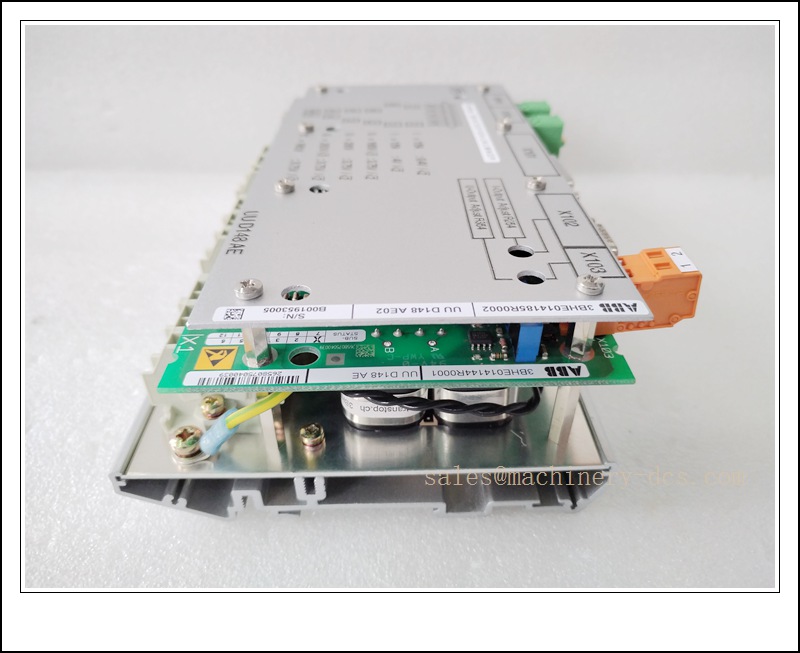
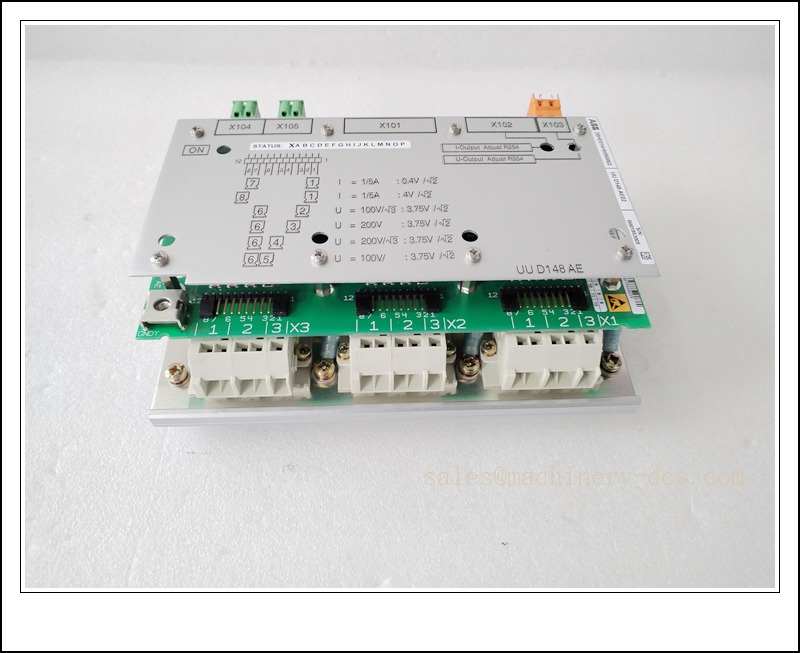
Description
Product Core Introduction
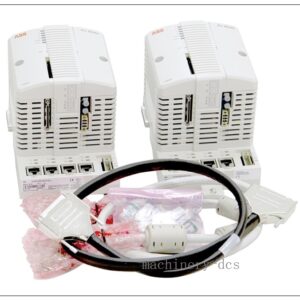
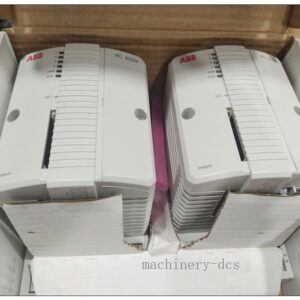
The ABB 3BHE014185R0002 UUD148AE02 is an upgraded high-performance excitation current conversion and interface unit belonging to ABB’s UNITROL® 5000/6000 static excitation system family. Manufactured at ABB’s power generation facilities in Switzerland, it serves as the critical signal processing hub that converts raw analog current signals from generator current transformers into precision-calibrated digital/standard analog values for the excitation controller. As the enhanced successor to the UUD148AE01, it adds fiber-optic isolation and upgraded communication capabilities, drastically reducing EMI interference between low-voltage control logic and high-power thyristor power stages. It is widely deployed in thermal power, hydroelectric, and large industrial captive power plants, ensuring ultra-stable excitation regulation for synchronous generators.
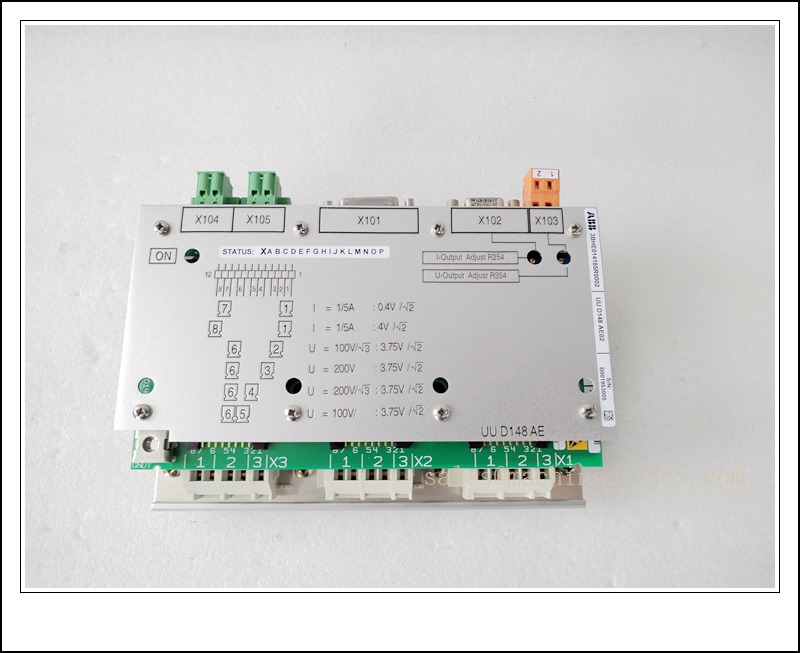
3BHE014185R0002 UUD148AE02
Key Technical Specifications
| Parameter | Details |
|---|---|
| Official Part Number | 3BHE014185R0002 |
| Model Designation | UUD148AE02 |
| Product Family | ABB UNITROL® 5000 / 6000 Static Excitation System |
| Core Function | High-precision excitation current signal acquisition, conversion, and galvanic isolation |
| Nominal Supply Voltage | 24 V DC internal system power input, with 1500 V AC reinforced isolation protection |
| Signal Processing | High-speed 16-bit ADC sampling for excitation current feedback, full-scale measurement accuracy ±0.05% |
| Communication Interfaces | Native fiber-optic, RS485, and 10/100 Mbps Ethernet multi-protocol support |
| I/O Capability | Dedicated high-speed digital and analog feedback channels for excitation loop closed-loop control |
| PCB Protection | Full conformal coating for dust, humidity, and industrial corrosive gas resistance |
| Mechanical Format | Standard Eurocard rack-mount footprint, fully backward compatible with UUD148AE01 |
| Net Weight | Approximately 1.475 kg |
| Country of Origin | Switzerland |
| Operating Temperature Range | 0°C to +70°C |
| Storage Temperature Range | -40°C to +85°C |
Recommended Models from the Same Series
For users exploring compatible alternatives or extended functionality within ABB’s excitation control portfolio:
- UUD148AE01 (3BHE014185R0001): Base version excitation interface unit, fully pin-to-pin compatible for direct drop-in replacement in legacy UNITROL systems
- UUD148AE11: Enhanced communication variant with redundant fiber-optic ports, designed for critical safety excitation systems requiring zero communication downtime
- UNITROL 6000 Full Static Excitation System: Flagship ABB excitation platform that natively integrates this UUD148AE02 unit for large-capacity turbo-generator control
- AC 800PEC High-Power Converter Controller: Matched power conversion control system for heavy-duty industrial and renewable energy excitation applications
Safety Precautions Before Installation
- High-Voltage Lockout Compliance: Never perform any work on the excitation cabinet while the generator is energized. Complete full lock-out/tag-out (LOTO) procedures, confirm the generator field breaker is fully open, and discharge all stored energy in power capacitors before handling the module.
- Strict ESD Protection: Wear a properly grounded anti-static wrist strap at all times. The high-precision ADC components on this board are extremely sensitive to electrostatic discharge, which can cause permanent unrepairable damage.
- Fiber-Optic Safety: Never look directly into the active fiber-optic ports with the naked eye, as the transmitted optical signal can cause permanent eye injury.
- Qualified Personnel Requirement: Installation and configuration must be performed by certified technicians with specific training on ABB UNITROL excitation systems and high-voltage power generation equipment.
- Pre-Work Documentation Check: Review the official UNITROL 5000/6000 system manual and this module’s dedicated wiring diagram before starting any installation procedure.
Hardware Installation Steps
- Pre-Installation Inspection: Unpack the new module and verify no physical transit damage exists. Confirm the part number 3BHE014185R0002 UUD148AE02 exactly matches your system spare parts specification.
- Full System Isolation: Complete all LOTO procedures, isolate all control and main power supplies feeding the excitation cabinet, and confirm zero residual voltage on all terminals with a calibrated multimeter.
- Remove the Existing Unit: Clearly label every connected cable and its corresponding termination point. Release the front panel mounting fasteners, then carefully slide the old module out of its Eurocard rack slot.
- Insert the New Module: Align the new unit with the rack guide rails, insert it smoothly until the backplane high-speed connector fully engages, then tighten all front panel fasteners to the factory-specified torque.
- Restore All Wiring: Reconnect every pre-labeled cable strictly following the wiring diagram, verify correct polarity for all signal lines, and ensure all fiber-optic connectors are clean and properly seated.
- Final Visual Check: Confirm no loose wires, foreign debris, or improperly terminated connections exist inside the cabinet before proceeding to power-up testing.
System Configuration Procedure
- Controlled Power-Up: Restore the 24 V DC control power supply following the plant’s standard energization procedure, observe the module’s power-on self-test LED sequence, and confirm no initial fault indications.
- Communication Establishment: Connect the ABB excitation engineering workstation to the system, verify the UUD148AE02 unit is correctly recognized by the UNITROL main controller, and confirm stable fiber-optic link status.
- Parameter Migration: Load your existing validated excitation system parameter backup file, verify all current loop calibration values, PID control gains, and protection thresholds are correctly applied to the new module.
- Precision Calibration: Perform full-range excitation current calibration using a calibrated precision reference current source, confirm the module’s measured values match the reference instrument within the ±0.05% accuracy tolerance.
- Firmware Compatibility Check: Verify the module’s firmware version is fully compatible with your existing UNITROL system controller firmware, perform official firmware upgrade if required per ABB’s technical recommendation.
- Permanent Configuration Save: Once all parameters and calibration data are fully verified, save the complete configuration to non-volatile flash memory, and create a new encrypted backup file for future maintenance reference.
Post-Installation Verification Points
- Self-Diagnostic Status Check: Confirm all front-panel status LEDs show normal operation, with zero active fault or alarm codes reported by the module’s internal self-diagnostic system.
- Fiber-Optic Link Stability Test: Run 2 hours of continuous communication burn-in testing, confirm zero data packet loss or link interruptions between the UUD148AE02 and the main excitation controller.
- Measurement Accuracy Validation: Inject known reference current values across the full 0-120% rated excitation current range, confirm all measured values stay within the specified ±0.05% accuracy tolerance.
- Low-Level Excitation Functional Test: Perform a controlled reduced-voltage excitation test, verify the module correctly feeds back real-time current values and the excitation system responds smoothly to setpoint adjustments.
- Protection Function Simulation: Simulate excitation overcurrent and signal loss fault conditions, confirm the module correctly triggers the system protection interlock and alarm actions as designed.
- Generator No-Load Test: Energize the generator at no-load condition, verify terminal voltage regulation remains stable and excitation current feedback is consistent across the full operating range.
- Maintenance Documentation Update: Record the module replacement in the plant maintenance log, including the new unit’s serial number, installation date, and calibration test results for future traceability.
Application Scenarios & Key Features
- Application Scenarios:
- Thermal power plants: High-precision excitation current feedback control for large-capacity turbo-generators, ensuring stable grid-connected operation
- Hydroelectric stations: Excitation signal processing for high-head large-capacity hydro-generators, supporting rapid load change response
- Industrial captive power plants: Reliable excitation control for refineries, steel mills, and mining facility backup power generation assets
- Marine propulsion systems: Ruggedized excitation regulation for large shipboard synchronous generator power plants
- Key Features:
- Upgraded fiber-optic isolation design eliminates EMI interference between high-power thyristor stages and low-voltage control logic, drastically improving system anti-interference performance
- ±0.05% full-scale measurement accuracy, 50% higher precision than the base UUD148AE01 version, enabling more stable generator terminal voltage regulation
- Full backward mechanical and functional compatibility with legacy UNITROL 5000/6000 systems, supporting direct drop-in replacement without modifying existing cabinet wiring
- Industrial-grade extended temperature range and full conformal coating, ensuring reliable long-term operation in harsh power plant control room environments
Frequently Asked Questions (FAQs)
Q1: Can directly replace the older UUD148AE01 unit in my existing UNITROL system?
A: Yes, it maintains full pin-to-pin mechanical and signal compatibility. Only a simple current recalibration procedure is required after installation to restore full system performance.
Q2: What is the main performance improvement over the AE01 version?
A: The AE02 version adds native fiber-optic isolation, upgrades ADC sampling resolution, and improves measurement accuracy from ±0.1% to ±0.05%, with enhanced anti-EMI capability for high-noise industrial environments.
Q3: What software do I need to configure this module?
A: It is fully supported by ABB official UNITROL excitation system engineering software, which provides complete parameter configuration, calibration, and diagnostic functions.
Q4: What is the typical service life of this module under normal operating conditions?
A: With proper environmental control and regular maintenance, the module has a rated design service life of over 15 years for continuous operation in power generation facilities.

 Send an Email