
Description
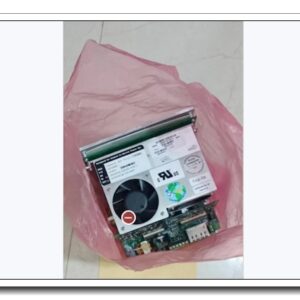
PM5630-2ETH — ABB AC500 V3 PLC Processor Module, 8 MB Memory, Dual Ethernet, RS232/485, CAN, Integrated Display
Executive Brief
The PM5630-2ETH (product ID: 1SAP131000R0278) is a high-performance processor module in the ABB AC500 V3 programmable logic controller family, designed for mid-to-large scale industrial automation applications. Equipped with 8 MB of user memory, dual independent Ethernet ports, native RS232/485 serial interface, CAN port, and a built-in front display, it delivers robust real-time control, flexible multi-protocol connectivity, and on-site diagnostic visibility without relying on external HMIs.
As a core member of the AC500 V3 platform, it is fully compatible with Automation Builder engineering software, supporting unified programming, configuration, and maintenance across the entire AC500 V3, AC500-eCo V3 product ecosystem. Its rich native interfaces eliminate the need for additional communication expansion modules, reducing cabinet space occupation and system hardware costs, making it an ideal choice for industrial scenarios that require high reliability, multi-network access, and convenient on-site operation.
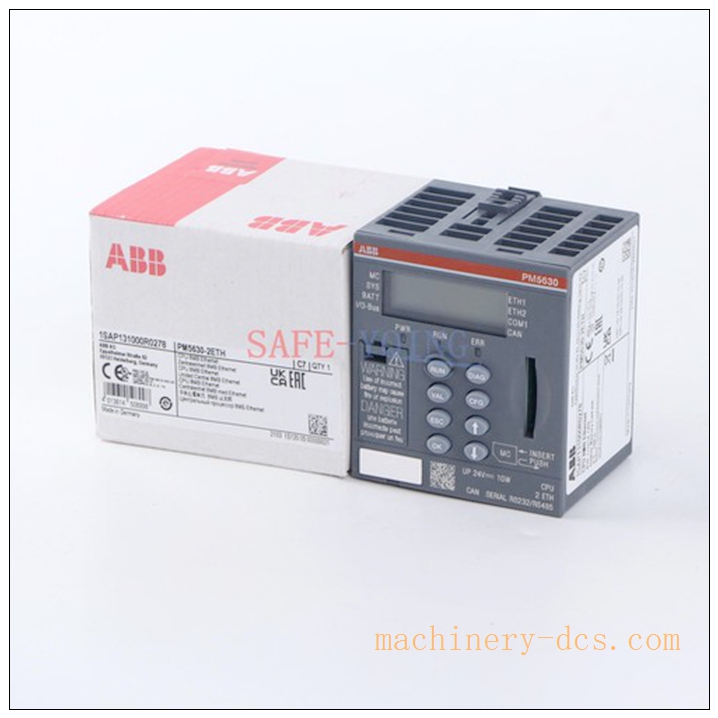
PM5630-2ETH
Core Technical Specifications
| Specification | Value |
|---|---|
| Product Family | ABB AC500 V3 PLC |
| Product ID | 1SAP131000R0278 |
| User Memory | 8 MB |
| Onboard Interfaces | 2 × Ethernet, 1 × RS232/485, 1 × CAN |
| Integrated Display | Yes, front panel status and diagnostic display |
| Programming Environment | Automation Builder, supporting IEC 61131-3 standard languages |
| Supported Protocols | TCP/IP, Modbus TCP/RTU, CANopen, ABB proprietary fieldbus protocols |
| Operating Temperature Range | 0 … 60 °C |
| Certifications | CE, UL, cULus, and other global industrial safety certifications |
| System Compatibility | Fully compatible with V3 series I/O modules, expansion cards, and accessory systems |
| Documentation Resources | 89+ official downloadable documents including datasheets, manuals, application notes, and security advisories |
Key Features & Benefits
- 8 MB High-Capacity Memory
Supports large-scale control logic, massive tag databases, complex motion programs, and data logging tasks, meeting the computing demands of medium and large automation systems. - Dual Independent Ethernet Ports
Enables network redundancy, segmented control network architecture, and simultaneous connection to office IT systems and on-site control networks, avoiding single-point network failure risks. - Native Multi-Interface Integration
Built-in RS232/485 and CAN ports directly connect to traditional serial field devices, CANopen servo drives and sensors, eliminating extra gateway modules and reducing system cost. - Integrated Front Display
Real-time display of controller operating status, fault codes, and diagnostic information, allowing on-site engineers to quickly locate problems without connecting to a programming terminal. - Full V3 Ecosystem Compatibility
Seamlessly works with all V3 series I/O modules, expansion accessories, and CP600 HMI products, supporting unified development in Automation Builder to cut engineering cycle time. - Abundant Official Technical Resources
Provides 89+ downloadable documents covering application notes, certificates, system manuals, security advisories, and software packages, facilitating full lifecycle development, commissioning, and maintenance. - High Industrial Adaptability
Rugged hardware design meets strict industrial EMC, temperature, and vibration standards, stably operating in harsh manufacturing, energy, and infrastructure environments.
Application Scenarios
- Factory Automation Production Lines: Used for stamping, packaging, assembly, and logistics sorting lines that require multi-device interconnection and high real-time performance.
- Water Treatment & Environmental Engineering: Applied in sewage treatment plants, water supply pumping stations, and environmental monitoring systems, supporting multi-sensor data collection and remote transmission.
- Energy & Power Control: Suitable for small and medium hydropower stations, distributed photovoltaic systems, and power distribution automation control scenarios.
- Smart Building & HVAC: Controls large commercial building HVAC, energy management, and public facility automation systems.
- Process Skid OEM Equipment: Serves as the core controller for chemical, pharmaceutical, and food processing skid-mounted equipment, meeting standardized and modular control requirements.
- Material Handling & Conveyor Systems: Deploys in port terminals, warehouse logistics conveyor lines, and automated three-dimensional warehouse control systems.
Related Model Recommendations
V3 Processor Module Comparison
| Model | Memory | Ethernet Ports | Key Differentiator |
|---|---|---|---|
| PM554-TP-ETH | 2 MB | 1 | Entry-level V3 controller for small automation systems |
| PM555-TP-2ETH | 4 MB | 2 | Mid-range model with dual Ethernet, no CAN interface |
| PM5630-2ETH | 8 MB | 2 | Flagship mid-size model with full set of native interfaces and display |
| PM5650-2ETH | 16 MB | 2 | High-end model with larger memory for complex process control |
| PM573-ETH | 32 MB | 1 | Top-tier high-performance controller for large-scale distributed systems |
Selection Guidance
- Choose PM5630-2ETH when you need 8 MB memory, full native interfaces, and on-site display for medium-sized projects that prioritize cost-effectiveness and convenient maintenance.
- Step down to PM555-TP-2ETH if your project does not require CAN interface and only needs 4 MB memory, reducing hardware investment.
- Step up to PM5650-2ETH if your system involves complex process control, massive data storage, and more I/O points, requiring 16 MB higher memory.
- Select PM573-ETH for large distributed control systems that need 32 MB memory and support for thousands of I/O points.
Frequently Asked Questions
Q1: What software does PM5630-2ETH use for programming?
It is programmed with ABB Automation Builder, which supports all IEC 61131-3 standard programming languages, and is fully compatible with the V3, -eCo V3 series product systems.
Q2: Can the dual Ethernet ports of PM5630-2ETH realize network redundancy?
Yes, the two independent Ethernet ports support network redundancy configuration, which can effectively avoid production interruption caused by single network cable or switch failure.
Q3: What devices can the onboard RS232/485 and CAN interfaces connect to?
The RS232/485 interface supports Modbus RTU, ASCII and other protocols, connecting to traditional instruments, sensors and frequency converters; the CAN interface can directly connect to CANopen servo drives and field devices.
Q4: How many official technical documents are available for ?
There are 89+ downloadable official documents, including datasheets, system manuals, application notes, certificates, security advisories and supporting software resources.
Q5: Can be directly compatible with old series I/O modules?
It is fully compatible with V3 series I/O modules, and can realize seamless interconnection with most series I/O through configuration adaptation, protecting your existing hardware investment.
Q6: What is the role of the integrated front display?
It can directly display the controller’s operating status, fault codes, and diagnostic information, allowing on-site engineers to quickly locate faults without connecting to a programming computer, greatly improving maintenance efficiency.

 Start Chat


 Send an Email