
Description
1769-L36ERM — CompactLogix™ 5370 L3 Motion Controller, 3 MB Memory, 16 Axis CIP Motion, 48 EtherNet/IP Nodes
Executive Brief
The Allen-Bradley 1769-L36ERM is a high-performance programmable automation controller (PAC) in the CompactLogix 5370 L3 family, engineered by Rockwell Automation to deliver scalable, cost-effective control for small- to medium-sized industrial applications. Positioned at the upper tier of the L3 series, it combines 3 MB of user memory, support for up to 16 axes of integrated motion over EtherNet/IP, and up to 30 local 1769 I/O modules—all in a compact, chassis-free form factor.
As a member of Rockwell’s Integrated Architecture™ system, the 1769-L36ERM uses the same Studio 5000 Logix Designer programming environment, network protocols, and information capabilities as all Logix controllers, providing a unified development environment across discrete, motion, process, and safety disciplines. Its dual EtherNet/IP ports with embedded Device Level Ring (DLR) support ensure resilient network topologies, while built-in energy storage eliminates the need for lithium batteries.
Ideal for OEM machine builders and end users alike, the 1769-L36ERM excels in packaging, material handling, assembly, and process skid applications where performance, motion capability, and footprint efficiency are critical.
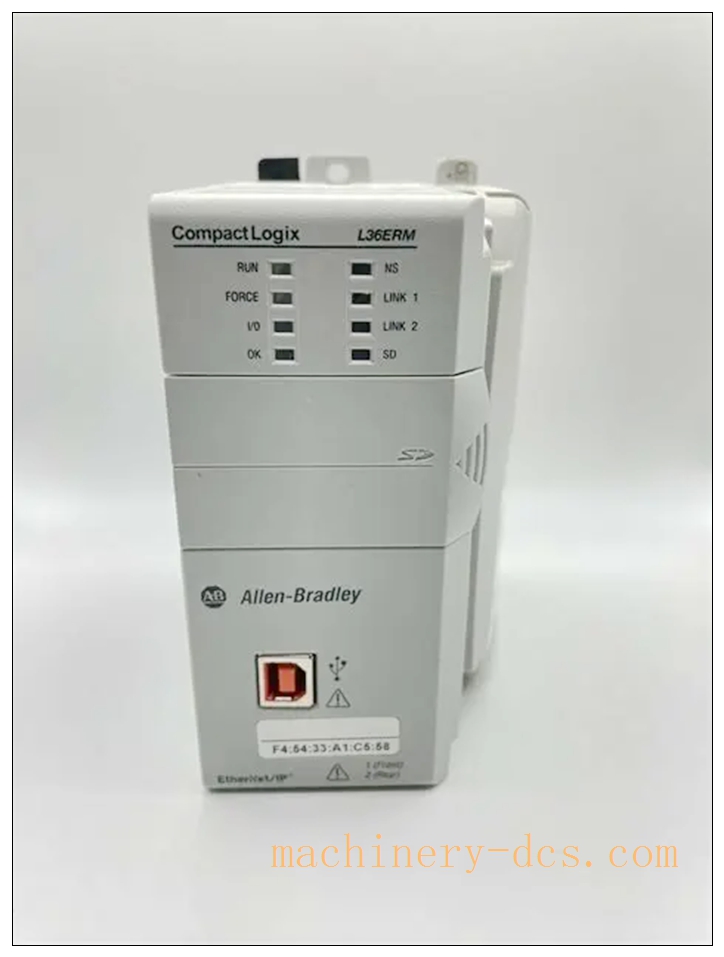
1769-L36ERM
Core Technical Specifications
| Specification | Value |
|---|---|
| Controller Family | CompactLogix 5370 L3 |
| User Memory | 3 MB (with supercapacitor backup) |
| Motion Axes | Up to 16 axes (CIP Motion over EtherNet/IP) |
| Local I/O Expansion | Up to 30 1769 Compact I/O modules |
| EtherNet/IP Nodes | Up to 48 nodes |
| TCP/CIP Connections | 256 |
| Built-in Communication | 2 × EtherNet/IP ports (embedded switch, single IP address) |
| Serial Port | RS-232 (DF1, ASCII, Modbus RTU support) |
| USB Port | 1 × USB (firmware download, programming) |
| SD Card | Removable 1 GB SD card (1784-SD1); upgradeable to 2 GB |
| Tasks & Programs | 32 tasks; up to 100 programs per task |
| Open Sockets | Up to 32 |
| Power Supply | 24V DC |
| Dimensions (W × H × D) | 55 mm × 132 mm × 105 mm |
| Weight | ~310 g |
| Operating Temperature | 0 … 60 °C (32 … 140 °F) |
| Relative Humidity | 5 … 95% (non-condensing) |
| Mounting | DIN rail or direct panel mount |
| Programming Languages | Ladder Logic, Structured Text, Function Block, SFC (IEC 61131-3 compliant) |
| Certifications | c-UL-us, CE, C-Tick, ATEX, KC, EtherNet/IP |
Key Features & Benefits
1. Integrated Motion on EtherNet/IP
Supports up to 16 axes of CIP Motion over a single EtherNet/IP network, eliminating the need for dedicated motion modules or separate motion controllers. When paired with Kinetix® 350 servo drives, it delivers a cost-effective, scalable motion solution for indexing tables, cam profiles, and multi-axis synchronization.
2. Device Level Ring (DLR) Resilience
Dual Ethernet ports with an embedded switch enable DLR network topologies, providing fault tolerance for single-point cable failures and allowing device replacement without stopping production. This reduces the need for external Ethernet switches and simplifies system architecture.
3. Battery-Free Energy Storage
Built-in supercapacitor energy storage eliminates lithium battery dependencies, reducing maintenance costs and hazardous material handling. The controller retains program and data integrity during power loss without consumable batteries.
4. Flexible & Scalable I/O
Supports the full range of 1769 Compact I/O™ modules—digital, analog, high-speed counter, thermocouple, RTD, and specialty modules—across up to 30 local modules. Existing 1769 I/O investments can be reused, protecting legacy hardware during migrations.
5. 3 MB Memory with SD Card Integrity
3 MB of user memory handles complex logic, large tag databases, and motion programs. A removable 1 GB SD card (upgradeable to 2 GB) provides non-volatile program storage, fast save/restore, and secure data integrity for IP protection.
6. Open Socket & Multi-Protocol Support
Open socket capability enables Modbus TCP communication and direct connectivity to printers, barcode readers, weigh scales, and servers—without additional gateway hardware. CIP Safety can run alongside standard CIP on the same network.
7. Kinematics Support
Built-in kinematics function supports up to 2 axes of articulated robotic motion, eliminating the need for separate robot controllers and software in simple pick-and-place and gantry applications.
8. Unified Development Environment
Programmed with Studio 5000 Logix Designer, sharing the same tag database, instruction set, and engineering tools as ControlLogix and other Logix family controllers. AOIs (Add-On Instructions), UDTs, and HMI tag structures are fully reusable, reducing engineering effort by up to 30%.
9. Compact, Chassis-Free Design
DIN-rail or panel-mountable with no chassis required, maximizing cabinet space efficiency. Modules can be placed on either side of the power supply (up to 8 per side), offering flexible layout options.
10. Conformal Coating Option
Available with conformal coating (CC suffix) for protection against harsh environments with moisture, dust, and chemical exposure.
Application Scenarios
Packaging Machinery
Case packers, erectors, form/fill/seal machines, labelers, and palletizers benefit from 16-axis motion control, high-speed I/O, and DLR network resilience for line-level integration.
Assembly & Material Handling
Conveyor systems, indexing tables, robotic pick-and-place cells, and automated assembly lines leverage the controller’s kinematics support and multi-axis synchronization.
Process Skids & Batch Control
Food & beverage, pharmaceutical, and chemical processing skids use the L36ERM for PID control, analog processing, and batch sequencing with its 3 MB memory and modular analog I/O options.
Machine Tool & Metal Forming
Presses, injection molding machines, and CNC retrofits take advantage of high-speed counters, motion coordination, and open-socket connectivity to HMIs and MES systems.
Water & Wastewater
Pump control, filtration systems, and SCADA integration benefit from rugged industrial design, DLR reliability, and Modbus TCP support for third-party field instruments.
Building Automation / HVAC
Large HVAC systems, energy management, and lighting control use the controller’s compact form factor, networking flexibility, and scalable I/O.
OEM Machine Building
OEMs value the L36ERM for its balanced performance-to-cost ratio, software reusability across product lines, and compatibility with the Rockwell ecosystem that many end users already standardize on.
Related Model Recommendations
CompactLogix 5370 L3 Series Comparison
| Model | Memory | Motion Axes | Local I/O Modules | EtherNet/IP Nodes | Key Differentiator |
|---|---|---|---|---|---|
| 1769-L30ER | 1 MB | — | 8 | 16 | Entry-level L3; no motion |
| 1769-L30ERM | 1 MB | 4 | 8 | 16 | Basic motion (4 axes) |
| 1769-L33ER | 2 MB | — | 16 | 32 | Mid-range; no motion |
| 1769-L33ERM | 2 MB | 8 | 16 | 32 | Balanced motion (8 axes) |
| | 3 MB | 16 | 30 | 48 | Sweet spot for multi-axis machines |
| 1769-L37ERM | 4 MB | 16 | 30 | 64 | Higher network capacity |
| 1769-L38ERM | 5 MB | 20 | 30 | 80 | Top-tier L3 performance |
Safety & Specialty Variants
- 1769-L36ERMS — Compact GuardLogix SIL 3 / PLe safety controller, 3 MB standard + 1.5 MB safety memory, 16 motion axes
- 1769-L36ERMO — On-Machine™ (IP67) version for decentralized, cabinet-free installations
- 1769-L36ERMOS — On-Machine safety controller (IP67 + SIL 3 / PLe)
- 1769-L30ER-NSE — Non-storage energy version for hazardous locations (mining, oil & gas)
Selection Guidance
- Choose the 1769- when you need 16-axis motion, up to 30 local I/O modules, and 48 EtherNet/IP nodes in a compact footprint—typical for multi-station packaging machines, complex assembly cells, and process skids.
- Step down to L33ERM if you only need 8 axes and 16 I/O modules, saving on cost.
- Step up to L37ERM/L38ERM if your application requires more network nodes (64–80) or additional memory (4–5 MB).
- Consider L36ERMS when functional safety (SIL 3 / PLe, Cat. 4) is required alongside motion and standard control.
Frequently Asked Questions
Q1: What programming software does the 1769- use?
The controller is programmed with Studio 5000 Logix Designer (v21 and later). It is not compatible with RSLogix 500 or Connected Components Workbench as a primary programming tool. You can use BOOTP-DHCP or Studio 5000 to configure the IP address.
Q2: How do I set the IP address on a new 1769-?
Factory-fresh units have BOOTP enabled by default. You can assign an IP using the Rockwell BOOTP/DHCP Server utility (included with RSLinx Classic and Studio 5000). Alternatively, connect via USB cable and use Studio 5000 to set the IP directly.
Q3: How many motion axes can the support?
Up to 16 axes of CIP Motion over EtherNet/IP. This includes servo drives (e.g., Kinetix 350, 5500), VFDs with CIP Motion support, and virtual axes for camming and gearing.
Q4: Does the 1769- need a battery?
No. It uses built-in supercapacitor energy storage to retain program and data during power loss, eliminating lithium battery maintenance and disposal requirements.
Q5: Can I reuse my existing 1769 I/O modules?
Yes. The 1769- supports the full catalog of 1769 Compact I/O modules. Up to 30 modules can be connected locally across up to 3 I/O banks (using expansion cables and additional power supplies).
Q6: What is the maximum number of EtherNet/IP nodes?
The 1769- supports up to 48 EtherNet/IP nodes and 256 TCP/CIP connections.
Q7: What SD card does it use and can I upgrade it?
The controller ships with a 1 GB 1784-SD1 card and can be upgraded to a 2 GB 1784-SD2 card. The SD card stores the user program, firmware, and provides non-volatile data backup.
Q8: What is Device Level Ring (DLR) and why does it matter?
DLR is a network topology supported by the dual Ethernet ports that creates a fault-tolerant ring. If a single cable or device fails, the network reconfigures within milliseconds to maintain communication, enabling device replacement without shutting down the line.
Q9: Can the communicate with Modbus TCP devices?
Yes. Through its open socket capability (up to 32 sockets), the controller supports Modbus TCP client/server communication and can connect directly to printers, barcode readers, weigh scales, and third-party devices without external gateways.
Q10: What is the difference between and L36ERMS?
The L36ERMS is a Compact GuardLogix safety controller with an additional 1.5 MB of safety memory and certified SIL 3 / PLe (Cat. 4) functional safety capability. The is a standard controller without integrated safety.
Q11: What are the installation requirements?
Mount on DIN rail or panel, with the controller positioned within 4 modules of the power supply. Maintain approximately 50 mm of clearance above, below, and on both sides for ventilation. Install an end cap (1769-ECR) on the rightmost module.
Q12: Is the 1769- suitable for hazardous environments?
Standard models are not rated for hazardous locations. For mining, oil & gas, and explosive atmosphere applications, consider the 1769-L30ER-NSE (non-storage energy) variant, or consult Rockwell Automation’s hazardous location product catalog.

 Start Chat


 Send an Email