
Description
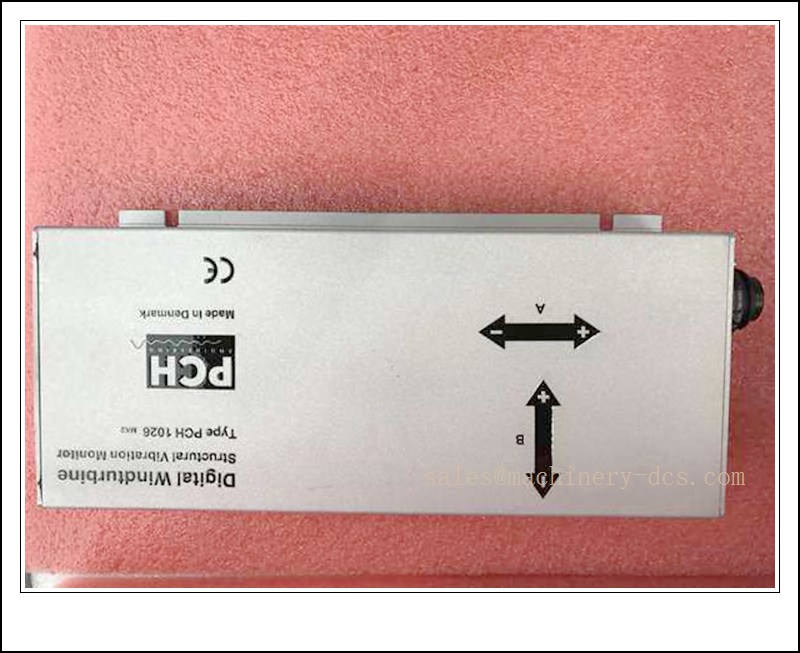
PCH 1026 Mk2 GL-Certified Digital Low-Frequency Structural Vibration Monitor
Brand: PCH Engineering
Product Line: PCH Wind Turbine & Structural Machinery Condition Monitoring System Family
Part Number Aliases: PCH 1026, PCH 1026 Mk2, PCH 1026 Wind Turbine Vibration Monitor
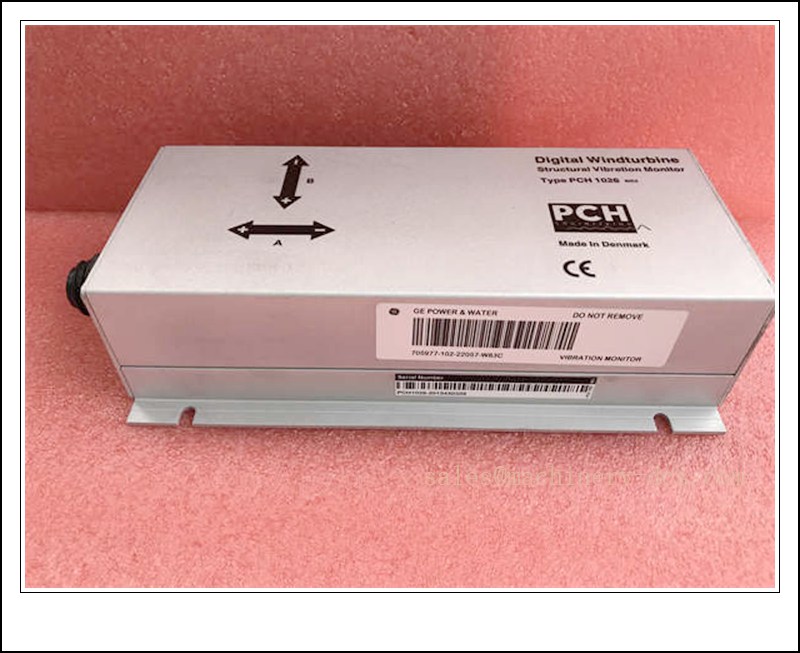
PCH 1026
Core Technical Specifications
| Parameter | Verified Specification |
|---|---|
| Manufacturer | PCH Engineering (Denmark origin) |
| Product Type | GL-Certified Digital Low-Frequency Structural Vibration Monitor |
| System Compatibility | PCH CHB 1101/1102 series external accelerometers, PLC/DCS systems |
| Built-in Sensors | 3-axis (X/Y/Z) internal accelerometer |
| External Sensor Channels | Up to 4 independent external accelerometer inputs |
| Dynamic Measurement Range | ±6 g peak |
| Standard Frequency Band | 0.1–200 Hz |
| Optional Extended Frequency Band | 0.1–1000 Hz (for 2 dedicated bands) |
| Supported Measurement Parameters | Acceleration, velocity, displacement (proximity probe optional) |
| Signal Detection Modes | RMS, Peak, Peak-Peak fully selectable |
| Analog Outputs | Up to 4 channels 4–20 mA, ±0.1 mA precision |
| Analog Output Load Limit | < 450 Ω |
| Alarm Relays | 4 independent configurable solid-state alarm relays |
| Failsafe System Failure Relay | 1 dedicated watchdog-controlled system fault relay |
| Relay Rating | 100 mA / 30 V DC per channel |
| Communication Interfaces | RS232, RS485, Modbus RTU; optional CANopen, Profibus, Profinet, Ethernet TCP |
| Power Supply | 20–30 V DC |
| Maximum Power Consumption | 7 W |
| Operating Temperature | -20 °C to +50 °C |
| Storage Temperature | -35 °C to +70 °C |
| Humidity Rating | 95% RH non-condensing at 40 °C |
| Protection Rating | IP54 |
| Physical Dimensions | 254 × 130 × 66 mm |
| Net Weight | ~2 kg |
| Safety Certifications | GL 2010 certified, SIL 2, PL-d (ISO 13849-1) |
| Standard Warranty | 12 months |
Main Features and Advantages
- Wind Industry Native Design: Developed in close collaboration with leading global wind turbine manufacturers, now protecting over 120,000 operating wind turbines worldwide.
- Multi-Sensor Full Compatibility: Integrates 3 built-in accelerometer axes, and supports up to 4 external CHB 1101/1102 series low-frequency accelerometers for distributed monitoring points.
- Ultra-Wide Low-Frequency Coverage: 0.1–200 Hz standard band, with optional 0.1–1000 Hz extended band for both structural and drive train vibration monitoring.
- Full GL-Certified Safety Functions: Natively integrates Germanischer Lloyd certified Safety Shock Detection (SSD) and Tower Frequency Detection (TFD) for wind turbine safety chain compliance.
- 12 Simultaneous Filter Bands: 12 independent real-time conditioning filter bands support simultaneous targeted monitoring of multiple critical vibration frequency components.
- Built-in FFT Analysis: Dual-channel ZOOM FFT function tracks tower resonance frequency changes, detecting tower base looseness and concrete tower cracks at an early stage.
- Full Self-Test & Diagnostics: Internal watchdog continuously monitors system health, triggering the failsafe system failure relay for power loss, processor halt, or sensor faults.
- Highly Modular Configuration: Over 200 I/O configuration combinations support flexible function expansion without hardware replacement, adapting to evolving monitoring requirements.
Application Scenarios
- Full structural vibration monitoring unit for onshore and offshore wind turbines
- Wind turbine tower, blade, nacelle, main bearing, and gearbox vibration health monitoring
- Low-frequency structural vibration monitoring for large civil engineering structures, bridges, and industrial buildings
- Legacy PCH 1026 system retrofit, preventive maintenance, and spare part replacement projects
- Industrial automation systems requiring GL-certified SIL 2 vibration monitoring for wind power generation sites
Related Model Recommendations
- CHB 1101: PCH external dual-direction low-frequency accelerometer that natively pairs with PCH 1026 for advanced nacelle distributed monitoring.
- CHB 1102: PCH external single-direction low-frequency accelerometer variant for single-axis dedicated measurement requirements.
- PCH 1072: PCH standalone compact vibration monitor for small-scale single-point machinery protection applications.
- PCH 1270: PCH multi-channel rack-based vibration monitoring system for large-scale plant-wide condition monitoring deployments.
Related News & FAQ
- Q1: What is the typical market price range? A: Authorized global distributors list pricing from USD 1200–3500, depending on unit condition, stock quantity, and regional supply chain availability.
- Q2: Is this part still in active production? A: PCH Engineering has not issued an official end-of-life notice; new original, surplus, and refurbished units remain widely stocked across global industrial automation suppliers.
- Q3: What safety certifications does it hold? A: It is GL 2010 certified, SIL 2 compliant, and rated PL-d according to ISO 13849-1 functional safety standard.
- Q4: What is the standard delivery lead time? A: Most distributors with in-stock inventory can ship via international courier (DHL/FedEx) within 5–10 working days.
- Q5: Does it support automatic accelerometer parameter recognition? A: Yes, connected CHB 1101/1102 accelerometers store factory calibration data in an on-board memory chip, and the monitor automatically adapts settings without manual reconfiguration.

 Send an Email