
Pumps, fans, compressors, and conveyors on an industrial site are all driven by electric motors. The wrong device shows up quickly: premature motor failures, inrush-current problems on the supply, or a drive specified for speed control where only a managed start was needed.
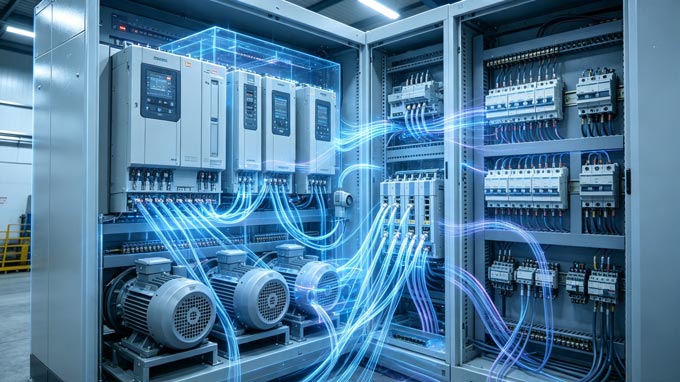
VFD vs. Soft Starter: How to Choose the Right Motor Control Solution
Motor starting falls into three main categories: direct-on-line (DOL), soft starter, and variable frequency drive (VFD). DOL starting draws inrush current of 6 to 10 times rated current and is suitable only for small loads that can tolerate a hard start. A soft starter ramps voltage progressively during startup to limit inrush and mechanical shock, then a bypass relay engages and it steps out of the circuit once the motor reaches speed. A VFD varies both frequency and voltage to control speed throughout the operating cycle.
Does the application require speed variation during operation? If variable speed is needed, such as flow control on a pump, adjustable conveyor speed, or variable fan pressure, a VFD is the choice, and it lets you capture energy savings from variable-torque loads. VFDs also include soft start, overload protection, fault logging, and thermal monitoring, and they accept analog or digital speed references for easy connection to a PLC or SCADA system.
Where the motor runs at full speed and the goal is simply a controlled start, limiting inrush, protecting mechanical drives, or reducing peak starting demand, a soft starter is more economical and takes up less panel space. Most units also offer a soft-stop function to prevent water hammer when stopping a pump. On lifecycle cost, a VFD has a higher upfront price, but energy savings from variable-torque loads can offset it over time; for constant-speed, constant-torque applications that payback does not hold, and a soft starter is the more cost-effective choice.





 Start Chat


 Send an Email