
Description
NI-9234 C Series Sound and Vibration Input Module: Full Technical Introduction
The NI-9234 is a high-performance 4-channel C Series dynamic signal acquisition module purpose-built by National Instruments (now part of Emerson’s Test & Measurement business) for precision sound and vibration measurement applications. Designed to deliver synchronized, high-fidelity signal capture for industrial condition monitoring, structural analysis, and dynamic testing workflows, it is a trusted hardware staple for engineers working with IEPE and non-IEPE motion sensors across industrial and research environments.
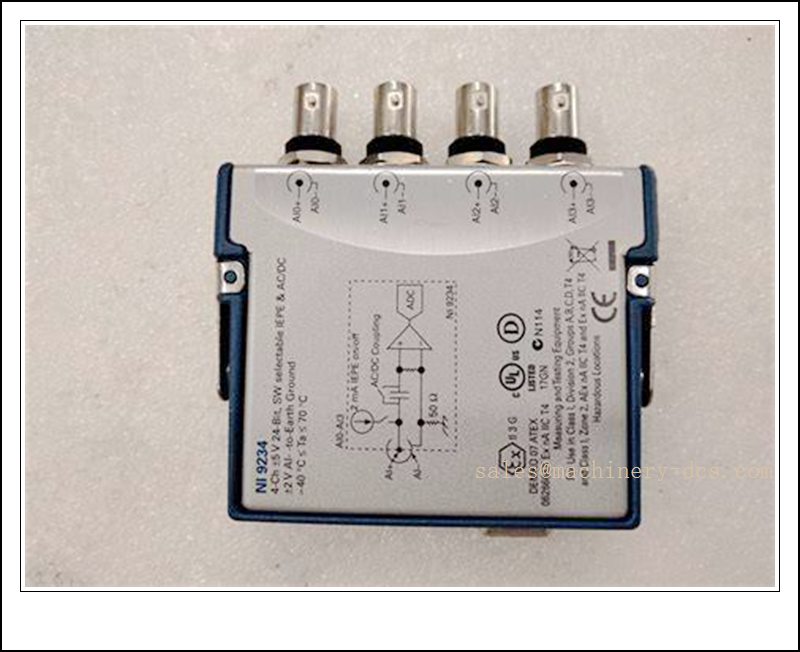
NI-9234
Core Product Information
| Parameter | Detailed Specification |
|---|---|
| Official Part Numbers | 779680-01 (standard), 779680-03 (conformal coated), 783440-01 (legacy limited support) |
| Manufacturer | National Instruments (Emerson Test & Measurement) |
| Product Series | NI C Series Dynamic Signal Acquisition Platform |
| Device Type | 4-Channel Simultaneous Sound & Vibration Input Module |
| Supported Hardware Platforms | All NI C Series chassis, CompactRIO, CompactDAQ, and compatible embedded systems |
| Front Connectors | 4x BNC interfaces for direct field sensor connection |
| ADC Architecture | 24-bit Delta-Sigma with integrated analog prefiltering |
| TEDS Compliance | Full IEEE 1451.4 smart sensor support |
| Starting List Price | ¥24,100 CNY / $3,717 USD (standard non-coated variant) |
| Warranty | 1-year original factory standard warranty |
| Typical Use Cases | Rotating machinery condition monitoring, structural vibration testing, acoustic noise analysis, order tracking for rotating equipment |
Key Technical Specifications
Signal Acquisition Performance
- Channel Count: 4 fully independent differential analog input channels
- Max Sampling Rate: 51.2 kS/s per channel, with 100% simultaneous sampling across all 4 channels
- Input Voltage Range: ±5 V full-scale, optimized for standard IEPE sensor output levels
- ADC Resolution: 24-bit Delta-Sigma architecture, delivering 97 dBFS dynamic range for ultra-low noise measurement
- IEPE Excitation: 2 mA constant current source per channel, software-enabled for direct powering of integrated electronic piezoelectric sensors
- Coupling Modes: Software-selectable AC/DC coupling, with a fixed 0.5 Hz high-pass filter cutoff for AC-coupled vibration measurements
- Anti-Aliasing Protection: Per-channel built-in auto-adjusting anti-aliasing filters that dynamically tune their response to match the active sampling rate, eliminating aliasing artifacts without manual configuration .
Electrical & Mechanical Characteristics
- Bus Interface: Native C Series backplane connection, no external auxiliary power required for core operation
- Input Isolation: No channel-to-channel or channel-to-bus isolation, designed for low-noise single-ground-reference measurement setups
- Sealing Rating: Fully sealed front-end circuitry to resist dust and minor environmental contamination in industrial cabinet deployments
- Conformal Coated Variant: The 779680-03 SKU adds a protective conformal coating for enhanced moisture and corrosion resistance in harsh industrial atmospheres .
- Net Weight: ~0.18 kg, optimized for dense multi-module stacking in CompactDAQ and CompactRIO chassis
- Operating Temperature Range: -40°C to +70°C, rated for extreme industrial and outdoor field deployment conditions .
Core Functional Advantages
- Simultaneous Synchronized Sampling: All 4 channels capture vibration signals at exactly the same timestamp, eliminating phase shift errors that break accurate modal analysis and cross-channel vibration correlation.
- Native IEPE Signal Conditioning: The integrated 2 mA constant current excitation removes the need for external signal conditioners, reducing system complexity, cabling, and total setup cost for accelerometer deployments.
- Auto-Tuning Anti-Aliasing Filters: The hardware automatically adjusts filter roll-off and cutoff frequency to match your selected sampling rate, guaranteeing alias-free measurements without manual filter calibration.
- Smart TEDS Sensor Compatibility: IEEE 1451.4 TEDS support automatically reads sensor calibration parameters, serial numbers, and sensitivity values directly from connected smart accelerometers, cutting setup time and eliminating manual configuration errors.
- Wide Environmental Operating Envelope: The -40°C to +70°C industrial temperature rating and sealed construction make the module suitable for deployment in remote field sites, mobile test rigs, and unconditioned industrial control cabinets.
- Native NI Software Ecosystem Integration: Out-of-the-box compatibility with LabVIEW, Sound and Vibration Measurement Suite, and SystemLink delivers pre-built libraries for frequency domain analysis, order tracking, and real-time condition monitoring processing .
Recommended Compatible NI Models
- NI-9231 8-Channel Sound and Vibration Input Module (higher channel density alternative)
- NI cDAQ-9174 4-Slot USB CompactDAQ Chassis
- NI cRIO-9035 CompactRIO Embedded Controller
- NI-9232 3-Channel IEPE Analog Input Module
- NI-9239 4-Channel Isolated Analog Input Module
- BNC-BNC 50Ω/75Ω Coaxial Sensor Cables (0.9m, 2m variants)
- NI Sound and Vibration Measurement Suite Software
- LabVIEW Full Development System
Compatibility Notes & Installation Pitfalls
- BNC Grounding Best Practice: Never allow the metal shells of adjacent BNC connectors to touch each other, the module chassis, or the system backplane, as this will introduce ground loop noise and corrupt low-level vibration measurements .
- No Isolation Warning: The module provides no galvanic isolation between channels or to the host bus; never connect it directly to signals with common-mode voltages exceeding the specified ±5 V range, as this will cause permanent hardware damage.
- TEDS Sensor Limitation: TEDS auto-configuration only works with IEEE 1451.4 compliant smart sensors; standard non-TEDS IEPE accelerometers will operate normally but require manual sensitivity value entry in software.
- Conformal Coating Deployment: The coated 779680-03 variant is intended for high-moisture, high-corrosion industrial environments; it is not required for standard laboratory or clean control cabinet deployments.
- Sampling Rate Alignment: For accurate order tracking on rotating machinery, always set the sampling rate to an integer multiple of the tachometer pulse frequency to avoid spectral smearing in the order domain.
Standard Operating Procedure (SOP) for Deployment
- Power off your selected C Series chassis, seat the NI-9234 firmly into an empty C Series slot, and confirm the module latches fully engage with the backplane connector.
- Connect your IEPE accelerometers, tachometers, or proximity probes to the front-panel BNC ports using shielded coaxial cables, ensuring all cable shields terminate to a single system ground point to eliminate ground loop noise.
- Launch NI MAX (Measurement & Automation Explorer), confirm the module is correctly detected by the host system, and install the latest NI-DAQmx driver to unlock all hardware features.
- In your LabVIEW or measurement application, configure each channel for your sensor type: enable IEPE excitation for accelerometers, select AC/DC coupling as required, and input sensor sensitivity values (or auto-load them via TEDS).
- Set your target simultaneous sampling rate, enable the built-in anti-aliasing filter, and perform a short signal calibration using a reference vibration calibrator to verify measurement accuracy.
- Capture baseline vibration data for your test asset, validate frequency analysis and order tracking outputs, and save the complete hardware configuration to your project for consistent repeatable measurements across test campaigns.
Typical Industrial Application Scenarios
The NI-9234 is the industry standard for portable and embedded dynamic measurement use cases including industrial pump and motor predictive maintenance monitoring, aerospace structural modal testing, automotive powertrain noise-vibration-harshness (NVH) testing, wind turbine gearbox condition analysis, and laboratory acoustic noise characterization for consumer product R&D.

 Send an Email